After leaving authoritarian Uzbekistan it was a relief to enter the much more chilled out atmosphere of Kazakhstan without policemen on every corner. Once again we marvelled at how crossing a random border resulted in dramatically different looking people: the Kazakhs are much more East Asian looking than the Uzbeks.
Kazakhstan has been the most fortunate of the Central Asian countries since independence from the USSR in the 1990's. Soon after independence massive oil deposits were found in the Caspian Sea and since then the income per capita has risen rapidly to above $20,000 per year - four times the next richest nation of Uzbekistan. (Turkmenistan, the hermit-like country which is difficult to visit is actually the 2nd richest Central Asian country.)
 |
| The world famous "Afri-Cola only to be found in Central Asia |
Kazakhstan's recent fortunes have also been inextricably linked to their charismatic president, Nursultan Nazarbayev, who was the Kazakh leader during the time of the USSR and who was a major player during the negotiations that led to the formation of the independent Central Asian countries. After the collapse of the Soviet Union, Kazakhstan endured incredible economic hardships as did the rest of Central Asia. Kazakhstan also experienced a number of additional challenges: more than half the population were ethnic Russians and Ukrainians so there were fears of annexation by Russia. The Soviets had also used Kazakhstan as the testing ground for their nuclear weapons leaving a horrific legacy of entire regions and communities damaged by nuclear waste. Kazakhstan also possessed a large arsenal of nuclear weapons which had leaders across the world on edge. Lastly, almost the entire Kazakh economy relied on heavily subsidised Soviet industries that promptly collapsed along with the USSR.
Given these challenges, it is remarkable to see how stable and prosperous Kazakhstan has become in just 20 years.
We first spent a couple of days in leafy Shymkent near the border of Uzbekistan where we spent our routine day or two trying to understand the eccentricities and costs of our new country. In every Central Asian country you will find dramatically different prices for the same products - some will be MUCH more expensive and others much cheaper. Uzbekistan was the land of expensive yoghurt and cheap fruit juice and ice-cream. Kazakhstan is the land of cheap yoghurt and cheap trains but expensive Shashlyk (kebabs). Dairy products, including yoghurt, are available in an impressive range in this region. While at home, and pretty much any country we've visited before, yoghurt is available in non-fat, full-fat or low-fat. Similarly milk is usually found in the form of skim-milk, 2% or full cream and pure cream comes in one type. Not in Kazakhsta!: here you will find a range across the full spectrum: 0%, 2.5%, 5%, 7.5%,10%, 20% ....all the way through to 100% for milk, yoghurt and cream. So if you want to make a really creamy mushroom sauce for your pasta and took, say, the 5% cream off the shelf, instead of the 20%, you may find yourself with a pasta sauce that is too runny but a milk product that is too creamy for your tea! We guess that this incredible range in dairy products can be linked to Kazakhstan's nomadic heritage where everyone relied on the milk products produced by their own herds.
 |
| "I'll have one of those...." Ordering food in Kazakhstan is a challenge |
From Shymkent we headed to the small town alongside the Aksu-Zhabagly nature reserve. There we stayed in a fairly pricey homestay (no shower) run by a friendly Russian lady - when desperate for a wash, we had a hose down in the garden with our swimming costumes on. We spent three days wandering around the reserve which was quite pretty but not spectacular. One of the more interesting things to see were the wild apple trees and berry bushes which are a major source of food for the numerous bears in the area. Apples originate in Kazakhstan. After the baking heat of Uzbekistan, the temperature changed literally overnight from mid 30's to low 20's and we had to wear shoes instead of flip flops for the first time in a month. Summer had ended. With an annual temperature range of -40 to +40, an overnight 10-15 degree change is nothing out of the ordinary.
 |
| Aksu Jabagly Nature Reserve, Kazakhstan |
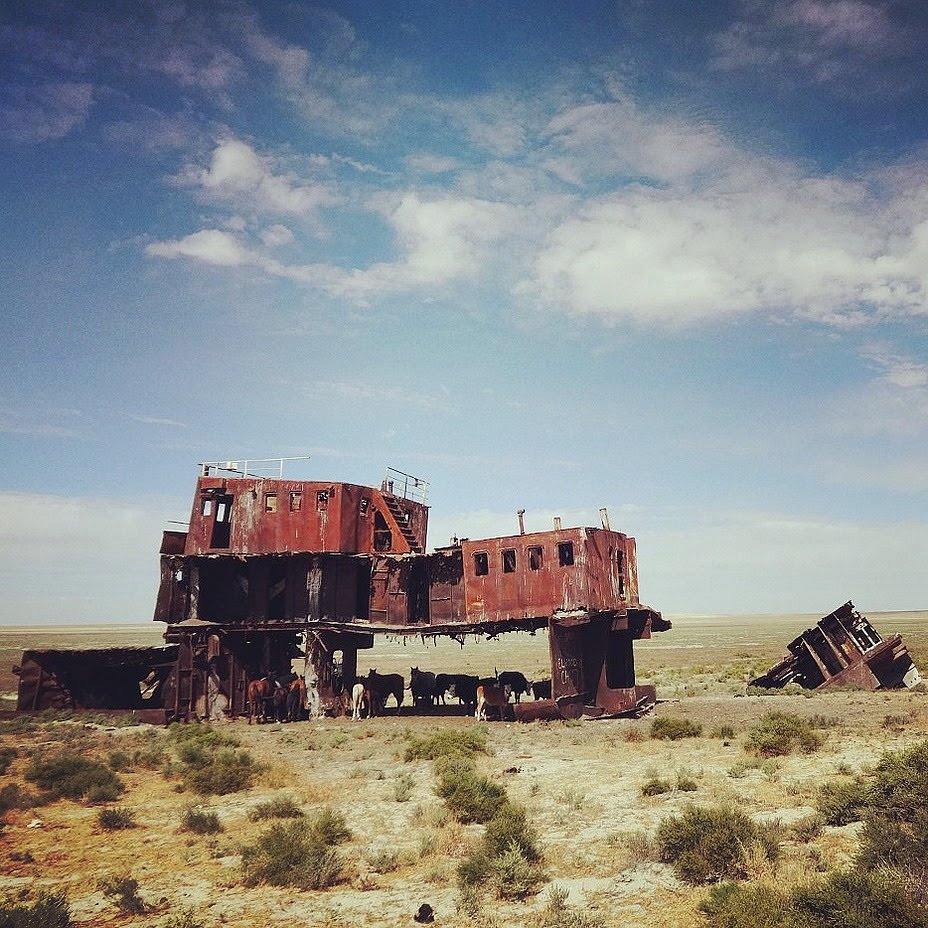
We headed next by overnight train to Aralsk far in the west of Kazakhstan and the site of what is commonly regarded as the worst man-made environmental disaster of all time. Not wanting to be beholden to the Americans for their cotton supplies, the Soviets decided that the grasslands and desert of Kazakhstan and Uzbekistan should be irrigated with water from the Oxus and Syr Darya rivers for growing cotton and wheat crops. These two rivers flowed from the epic mountains we climbed in Kyrgyzstan and Tajikistan into the middle of the desert forming a giant lake called the Aral Sea. This inland sea was about 400km long and 280km wide and rich in fish and bird life that sustained the communities along its shores for millennia. However, the amount of water that was diverted from the rivers for crop irrigation meant that there was not enough to keep the sea sufficiently replenished. By the 1980's the amount of water entering the Aral Sea was only a tenth of what entered during the 1950's and so the sea began to shrink rapidly. Towns that had had harbours on the sea shore were left stranded up to 80km away from the sea as the remaining water rapidly evaporated away. Fishing communities of over 60,000 people were forced to abandon their traditional lifestyles in search of work in faraway cities.
 |
| Pondering the Aral Sea, Kazakhstan |
We spent a night in Aralsk, the once thriving sea port which is now a dusty desert town. We took a bumpy four hour 4x4 trip through a bleak desert, now complete with its own resident camels, which had once been submerged under a sea. In the middle of the desert we found rusting ships that lay where they once upon a time floated... now more than 40km from the receding waters. In this sad and desolate ship-graveyard, cows rest in the shade among the maritime bits and pieces, while environmental activists have painted poignant ghosts of seafarers on the rusting hulks.
 |
| Aral Sea, Kazakhstan |
One bit of positive news is that Kazakhstan has taken a proactive approach and built a dam through the centre of what is left of the sea to avoid losing water to the Uzbekistan side of the sea. As a result the smaller, Kazakh part of the Aral Sea has begun to rise again. Unfortunately, the main part of the Aral Sea is in Uzbekistan which is making no genuine effort to reduce the amount of water used for crop irrigation and so the destruction on that side continues.
 |
| The sea was here.... Aral Sea, Kazakhstan |
From Aralsk we caught the train again back through the desert towards the east. On the way we spotted the Baykonur Cosmodrome – and discovered that most of the people who have been to Space lifted off from Kazakh soil. The Soviets chose to launch all their rockets from this remote part of the Kazakh desert and the Russians continue to use this base as part of a long term lease.
Whenever one travels by train in Central Asia, one has to first find the “Vokzal” which is the Russian name for “train station”. The story goes that when the first Russian engineers visited the UK to learn about these new machines called “trains” they were mightily impressed when they got off the train at Vauxhall train station in London. When they saw the name “Vauxhall” they assumed this was the generic word for “station” so from then on, Russians call all train stations “Vokzals”.
We spent a few difficult days on trains and dusty buses winding our way north through the desert via Kyzylorda and Zhezkazgan until we finally reached Astana, the recently created capital of Kazakhstan and the venue of the 2017 World Expo.
 |
| Astana, Kazakhstan |
President Nazarbayev decided that the old capital, Almaty, in the south-east of the country, should be changed as it left the north of Kazakhstan at risk of being absorbed by Russia due to the high number of Russian people living there. He decided that Astana, a smallish city in the freezing north, would become the new capital and began moving all government offices there in the late 90's. Many people thought this was a crazy scheme that could never work and resented having to move to a city without decent accommodation and restaurants in a brutally cold part of the country. For the first few years many senior civil servants had to sleep in dormitories as they tried to create a capital city out of very little. Fortunately the establishment of Astana corresponded with an increase in government revenues from the recently discovered Caspian Sea oil fields and so began an ambitious project to create Astana as an example of modern, avante garde architecture.
 |
| Khan Satyr shopping centre, Astana, Kazakhstan |
The main central boulevard begins with the remarkable Khan Satyr shopping centre. This building was designed by world-renowned architect Norman Foster and is shaped like a yurt (tent) with a special translucent skin that allows heat to enter but prevents this heat escaping. Inside is a multi-level shopping centre with the top level consisting of a tropical sandy beach with palm trees and large swimming pool - while outside the temperature can hit -35 degrees!.
 |
| Khan Satyr shopping centre, Astana, Kazakhstan |
As we walked down the boulevard more and more strange and amazing buildings would appear - some leaning in unusual ways, others shaped like giant eggs – and all drawing you towards the imposing Bayterek Monument which stands about 100m high and consists of a tall latticed tower holding a giant golden orb which represents the egg of the mythical bird Samruk which is supposed to contain all human desires and happiness beyond human reach. We didn't pay to go inside but apparently there is a mould of the president's hand which, if you put you hand inside it, will blast you with a loud rendition of the Kazakh national anthem.
 |
| Palace of Peace, Astana, Kazakhstan |
 |
| Palace of Peace, Astana, Kazakhstan |
On the very far side of the boulevard is the pyramid-shaped Palace of Peace made from glass and steel. This building was also designed by Norman Foster and it hosts the triennial Congress of World and Traditional Religions which aims to bring all religions together peacefully.
 |
| Astana, Kazakhstan |
----------- And now, the final instalment of our Central Asian history lessons ---------------------
Central Asia's history is dominated by a single individual who probably had a greater impact on Asia and Europe than any other person in history: Ghengis Khan. His story is so incredible that we are doing it a disservice to summarise it here. The best (and free!) resource on Ghengis Khan that we HIGHLY recommend to anyone who seeks to understand just how amazing he was is Dan Carlin's free podcast: The Wrath of the Khans which you can download free here:
http://www.dancarlin.com/product/hardco re-history-43-wrath-of-the-khans-i/
(There are 5 parts in all - do yourself a favour and just listen to this story - truly amazing!!!)
Our very poor summary is that in 1162 a young boy, born to a poor family and who shows early signs of high intelligence but also brutality, grows up to form an army of horsemen, the likes of which had never been seen before. In just 20 years they conquer most of Asia and Eastern Europe forming the largest empire ever known and killing between 10 and 70 million people in the most brutal manner imaginable sowing terror across most of the Eurasian continent. This enormous Mongolian empire - so brutally created - leads to huge advances in civilisation as for the first time East and West are able to trade without fear of robbery en route (no-one was going to mess about in Mongolian territory!) but at the same time the Golden Age of Islam is destroyed as the great Islamic kingdoms in Baghdad, Persia, Khorezm, etc are completely destroyed.
To understand how the Mongolians were able to do this, it is important to understand that for all of human history until about 200 years ago, the quickest that human beings could move from one place to another was by horse. The Mongolians were perhaps the first people to tame horses (Ukrainians also claim this title) and were certainly the greatest horsemen that ever lived. Their mastery of horse riding was sealed when they invented stirrups that allowed them to ride without using their hands and thus they could shoot arrows in great numbers and accuracy while on horseback - stirrups were the most impactful wartime improvement until gunpowder was introduced onto the battlefield. (Trousers also originate in Kazakhstan - as you can imagine, togas, skirts and wraps just wouldn't cut it in this environment). Each Mongolian rider would travel with twenty horses which he would swap constantly to allow him to cover hundreds of kilometers a day. And all these horses would obey his verbal commands. The impact was as if a civilisation, which had tanks and cars, were fighting civilisations that could only travel on foot. The result was that Mongolian armies of 20,000 soldiers could defeat Asian and European armies of hundreds of thousands with ease.
Ghengis sent one of his sons to go checkout this place called "Europe" they had heard about. When they arrived in Giorgia and Ukraine with a small expeditionary force, they would send a messenger ordering these giant kingdoms to surrender to the mighty Khan or else face extermination. These giant kingdoms had never heard of this Khan and laughed off these silly nomads and so the Mongols would attack and destroy the opposing armies in days and then proceed to systematically kill every man, woman and child in the city. They had a very simple, but effective way of doing this: if there were 1 million people in the city, they would divide these people equally amongst all the soldiers - for example 50 people per soldier - and then the soldiers would execute them one by one using their swords.
 |
| This is the steppe, Kazakhstan. |
When the news of this new terror began to spread, in many cases it had its desired effect: entire kingdoms would just surrender peacefully to the Mongols and thus be absorbed into the new civilisation. But many kingdoms just couldn't believe that some lowly nomadic tribe, which was so poor that they wore mouse skins as clothes, could possibly defeat their giant Kingdom which had reigned for centuries as the leading civilisation of the region... and so they would resist, and be defeated and then be exterminated.
When the Mongols were about to invade what is now Beijing, 60,000 women jumped to their deaths from the city walls rather than be raped and butchered by the Mongols. Travellers at that time reported literal mountains of human bones and entire regions where the earth was oily from decomposed human flesh.
One interesting result of the Mongol era was that by destroying the Chinese and Islamic empires, the Mongols inadvertently facilitated the rise of the European powers which up until this point had been fairly minor players in world history.
But again, we must emphasise that the above is a gross oversimplification of a fascinating era. Listen to the Wrath of the Khans, you won't regret it!!! Game of Thrones fans, this is the real deal...!
---------------------------- end of Central Asian history lessons! --------------------------------------- -----
 |
| Astana, Kazakhstan |
We spent a couple of days in Astana admiring the architecture before heading north again to the small village of Burabay which is in a region filled with forests and lakes. Burabay is normally an expensive tourist destination for Russians and Kazakhs but the tourists had left along with the warmth and so much of the place was boarded up. We wandered around until we found some Azerbaijani guys making Shashlyk and they helped us find an apartment we could rent cheaply. It seems that the region has depopulated significantly over the years and so there are lots of empty apartments that are available to rent.
 |
| Burabay, Kazakhstan |
We spent three days wandering around chilly Burabay enjoying the beautiful views of the lakes surrounded by forests that were slowly changing into their red and yellow autumn outfits. At this point we were further north than the most northern part of Mongolia and we were freezing! Even though it was only autumn... by mid winter temperatures of minus 40 degrees are common here!
Kazakhstan is supposed to be by far the most expensive country in Central Asia and we had been concerned that we would struggle to travel there on our tight budget that was shrinking day by day as our home currency in South Africa slowly collapsed. But, by a stroke of luck, the Kazakh Tenge underwent a dramatic collapse just the week before we arrived which meant that prices were almost halved for us which was a real bonus.
So we bussed our way south again to Karaganda which is famous as the location of some of the Soviet's worst human rights abuses: this was the centre of the Karlac/Gulag. The Karaganda Labour Camp (Karlac) was a piece of land in Kazakhstan the size of France where the Soviets sent political prisoners to do hard labour for ten years at a time. Millions of people died here working outside in rags in temperatures of minus 40 degrees celsius. Truly horrific. Often, just being related to someone who said something bad about Stalin was enough to have them sentenced to a decade in Karaganda. There was one South African and his son (Henry Glazer) who in the 1930's had left South Africa to travel to the USSR to be part of the new communist utopia. Years later, the father was seen looking at Stalin with a strange look on his face during a speech and so he and his son were sent to Karaganda where they died.
 |
| The Karaganda Labour Camp (Karlac), Kazakhstan |
Besides people imprisoned for various offenses, this era also saw entire ethnic communities relocated across the USSR at whim. The army would arrive in some community (for example Chechnya), give the residents 30mins to pack and they would spend weeks and sometimes months being transported like cattle in trains to far flung areas of the Soviet Republic. Those who survived these horrific journeys were expected to make a new life with whatever they had, sometime in places with no infrastructure at all. They would spend their first nights with no shelter or food provided, often relying on sympathetic Kazakh nomad hospitality for survival. In some ways the Gulag prisoners were actually better off as at least they were taken to camps with shelter and food! There is an informative museum in the old Karlac administrative office where we spent a few hours learning about the brutal inhumanity of this terrible system.
From Karaganda we caught another overnight train to Almaty, the former capital of Kazakhstan. This leafy city beneath snow capped peaks is the most cosmopolitan in Central Asia and is filled with beautiful parks established by the Russians and lovely old buildings. Travelling in the old USSR is so full of contradictions: terrible brutality and environmental destruction contrasts with beautifully designed cities filled with tree-lined avenues, parks and fountains and stately old buildings. Many older Kazakh people talk warmly of the Soviet era...
 |
| Orthodox church, Almaty |
 |
| Intellectual property rights not a big deal in Kazakhstan |
 |
| Almaty, Kazakhstan |
Almaty has a nice subway train system where the stations cleverly double as art galleries. The bus system was also very efficient and worked purely on an honesty system - no-one bothered to check tickets yet everyone seemed to pay their way. Cheap meals could be had at canteens with delicious buffets and here and there one would find fake, rip-offs of famous western fast food brands. Bizarrely, there seemed to be few, if any Internet Cafes (hence the delay in our blog) but loads of online gambling shops. We wandered around the Green Bazaar which was great and generally enjoyed ourselves in the warmer climes of this southern city.
 |
| Subway station with art gallery, Almaty, Kazakhstan |
 |
| Powerful WW2 memorial from the Soviet era, Almaty, Kazakhstan |
 |
| Dried fruits in the Green Market, Almaty, Kazakhstan |
And then it was time finally to leave Central Asia and head back to China.... After a long bus journey, we over-nighted near the border and early the next morning caught a lift to the border crossing - proud of the fact that we had planned our money so well that we had only a handful of tenge left in our possession. But after much confusion it turned out the border was closed for three days due to a Chinese holiday... China must be the only country on earth that closes its borders on public holidays which is the time when people most want to travel!!!
This was incredibly frustrating and so we had to somehow get ourselves back to town and find somewhere to go for three days. We took various taxi rides in all sorts of crazy directions towards the mountains and, as the sun set, found ourselves hitching on the side of the road for hours in the middle of nowhere. Luckily we got a lift to the village of Saty where we ended up sleeping on the couch of the driver: not the way one imagines spending your tenth wedding anniversary!
 |
| Saty, Kazakhstan |
The next morning we bought supplies and hiked into a national park up to the beautiful Kolsai Lakes where we spent three days. We found a little cabin (no shower, no running water at all) where we managed to make ourselves comfortable. As we were about to dive into the beautiful tree-ringed lake there were alarmed shouts by park rangers... of course, no swimming in the lake... facecloth and water-jug showers... again! Our spirits were lifted by beautiful hikes into the mountains with alpine lakes and young Kazakh travellers who shared their vodka with us. Vodka is BIG in Kazakhstan.
 |
| Kolsai Lake, Kazakhstan |
 |
| 10th wedding anniversary picnic, Kolsai, Kazakhstan |
Once again we were counting our pennies and had to make sure we had enough to get back to the border which was 10 complicated travel hours away. We had to hike out of the park in the dark in order give ourselves a chance of making it to the border on time - being chased by vicious nomad dogs on the way (useful tip: dogs that live in mountains where there are wolves are very dangerous... always carry a big stick and be prepared to use it). Time was running out as we knew the border was closing at 6:30pm but we were doing OK until one of our hitched lifts decided to take a radical 100km detour to some remote nomad house where of course we had to have chai/choy and explain how we were in fact "Africans". Miraculously we made it to the border with 15min to spare and found it sort of closed but after many desperate please and pointing out that it was in fact 6:15pm, they allowed us through.
And then we jogged through to immigration to have our passports stamped out of Kazakhstan... elated that we had in fact made it.... the beautiful, blonde Kazakh immigration agent smiled sweetly and just as she was about to stamp our passport.... er.... nooooooo.... there was a problem... Kazakhstan se ma se ... !!!
So, here's the thing: Kazakhstan has an old, bizarre and simply STUPID law which says that when you enter Kazakhstan, in addition to your passport being stamped, you must have an immigration card that gets stamped twice. The first stamp must be on entry and then, after entering, you must spend a whole day registering yourself in the first city you arrive in. Once registered you get a second stamp on your Immigration Card.
However, if you enter Kazakhstan via the airport you get both stamps at the airport and recently, the immigration officials at land borders have been giving two stamps on entry too. The internet is filled with traveller websites explaining this process - which we had studied in detail prior to arriving in Kazakhstan. When we entered Kazakhstan we got TWO stamps on entry and two different immigration officials at the border confirmed that this meant we did NOT need to register in the nearest town. So, of course, now that we were exiting Kazakhstan, the officials were unhappy. They said that the Kazakh immigration officials were wrong to stamp our card twice and that we should have registered at the nearest town. So they confiscated our passports and we had to turn around and trudge back to Kazakhstan, frustrated beyond belief.
The immigration police dropped us at a local hotel and said they would fetch us and take us to court the next morning. Sure enough, the bossy official arrived the next morning and we headed off to the immigration head office where we spent a ridiculous few hours showing the officials that their own government website explained that you could receive two stamps on entry at land borders and them explaining to us kindly that no, their own immigration officials had made a mistake in stamping our cards twice on entry and, while politely apologising for this, saying that unfortunately we would have to pay a R10,000 ($800) fine!! We must make it clear that this was definitely not a corrupt, bribe-seeking process. These guys were doing everything by the book and they just could not see that it was wrong that we should pay a fine for their own official's mistake. Their argument was "yes our officials made a mistake, but as a result your broke the law and so you must pay the fine...".
We started to get really ****** off at this point and then said that we didn't have that kind of money so now what? Then someone mentioned "deportation" and slowly an alternative plan began to emerge. It turns out that many Chinese builders come and work in Kazakhstan and overstay their visas and then arrive at the border with "no money" and then get deported to China. So we began asking about this option with our main concern being: will we get a bright blue "DEPORTED" stamp in our passports which would affect future travels? The General of immigration was a nice guy who seemed genuinely sorry for us - so we reasoned with him and he promised that if we chose the DEPORTED option that he would personally make sure that we only got the normal tourist exit stamp. He did explain though that we would not be able to return to the country for five years... we assured him that somehow we would try our very best to cope with the devastating sadness of not being able to return to Kazakhstan but if that saved us paying the fine, we'd have to manage...
And so in the afternoon we headed off to court where we had to sign all sorts of documents in Russian that we, of course, didn't understand and then with the help of a translator we tried once more time to explain how we were not in the wrong to the judge who seemed sympathetic but who then asked anyway: "so you admit your guilt?" to which we of course had to say "ok yes." And because we confirmed that we didn't have the money for the fine, she then ruled that we would be deported in the morning.
The next morning we were collected from our hotel by the General and then whisked like VIPs through immigration... there we had a few tense moment when it seemed that the General and the blonde immigration lady seemed to be disagreeing about the "DEPORTED" stamp but when our passports were returned to us, we saw with relief that the stamp was just the normal exit stamp. The blonde lady looked genuinely sad when she said "but now you cannot come back to Kazakhstan for 5 years!" and looking at her, it was like there were a hundred totally different ways we could have responded on the spectrum from love to hate.... but we just smiled sweetly... and then a just a little while later we were standing with huge smiles in front of a friendly, efficient Chinese immigration official and in seconds we were through and outside, blinking, smiling in CHINA!!! It felt like we had come home.
And so, four months of truly epic travels in Central Asia had come to an end. It certainly was not a relaxing holiday in the typical sense but rather an epic adventure that we will never forget. A region that had once been a blank spot on our mental map of the world has now been filled in with magnificent mountains, stunning valleys, diverse cultures, bland foods, sweet fruits, ice-creams, lakes, yaks, horses, ancient civilisations, modern cities, interesting political systems, confusing languages, deserts, grasslands, flowers, glacial rivers, yurts, homestays, strange forms of public transport and shashlyk! But without question, the most memorable part of Central Asia is the legendary hospitality of its people - and to this day as we travel far away in other parts of Asia we find our selves unable to stop using the traditional Central Asian method of thanking someone by holding a hand over your heart while making a little bow of your head and murmuring "Ragmet!"